Product overview
Carbide drilling tools are consumed continuously in series production. Once a drill can no longer be reground within tolerance, the remaining carbide body enters the recycling chain as round tool scrap.
Drill scrap handled by Nautica Metal Scrap B.V. typically arrives mixed with other round tooling. Sorting focuses on confirming that the tools are solid carbide rather than carbide-tipped steel, and on removing packaging, sleeves and shop contamination.
For background on how drilling tooling fits into the wider hardmetal recycling market, see our tungsten carbide recycling and material guide.
Technical specification
This material is covered by our solid carbide cutting and tooling scrap specification, which sets out typical forms, identification, contamination and deduction factors, sampling and packing. Typical characteristics only — contractual specifications are agreed per lot.
Material identification
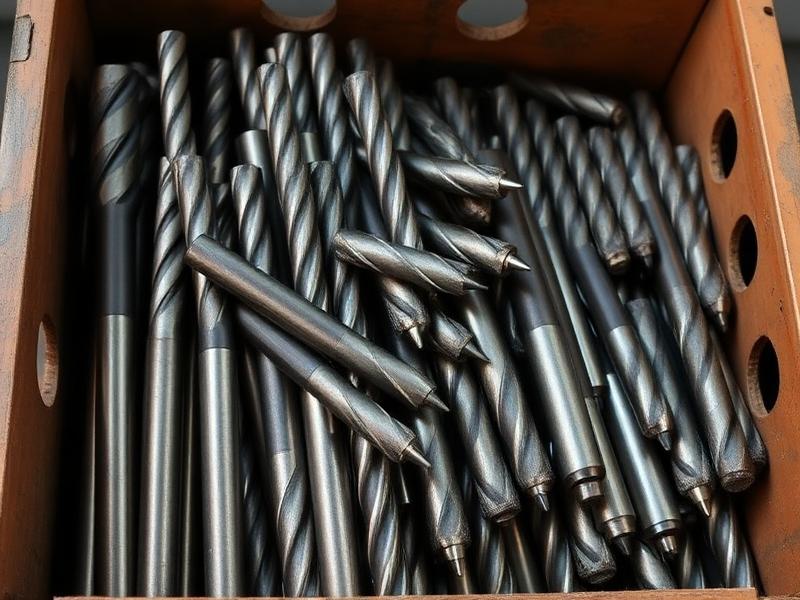
Solid carbide drills are recognised by their small diameter relative to length, the helical flutes running the full body, and in many cases internal coolant holes visible at the point. Micro-drills and PCB drills form a distinct sub-stream: very small diameters, often still mounted in plastic rings or carrier strips, and usually collected in high piece counts but low weight.
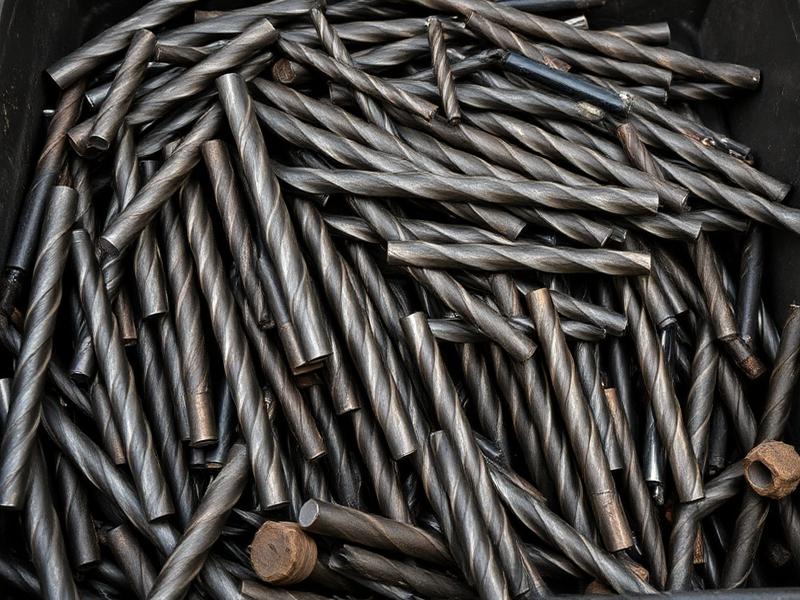
Because drills fail by breaking, this stream normally arrives as a mixture of complete tools, broken shanks and point fragments rather than as intact tooling. Fragmentation is expected and does not itself reduce the recoverable material.
- Solid carbide twist drills, including through-coolant designs
- Micro-drills and PCB drills, frequently still in plastic carrier rings
- Broken points, shank sections and flute fragments
- Regrind rejects and drills worn beyond their usable point geometry
What affects a drill scrap lot commercially
Three things dominate: the proportion of solid carbide against HSS drills of the same geometry, the volume of plastic carrier material shipped with micro-drills, and the amount of oil retained in coolant channels and flutes. Small-diameter tooling has a high surface area for its weight, so retained fluid is proportionally more significant than in heavier streams.
Composition varies by grade and lot; drill substrates are formulated for different workpiece materials and are not uniform across a collection. Final specifications are agreed for the individual lot or order.
- Solid carbide share versus HSS and cobalt HSS drills in the same container
- Plastic rings, strips, cases and carrier packaging in micro-drill collections
- Cutting oil retained in through-coolant channels
- Fine drilling swarf mixed into the collection bin
- Whether the parcel is a single production campaign or a long accumulation
Micro-drills and PCB tooling
PCB and micro-drill scrap deserves separate handling. The tools are individually tiny, the carrier rings can represent a meaningful share of gross weight, and the material is easily lost during transfer between containers. Keeping this sub-stream in its own labelled packages, rather than tipping it into general drill drums, makes the lot far easier to evaluate and price.
Packaging and preparation
- Sealed drums or lidded pails — small tools escape easily from bags and open boxes
- Micro-drills packed separately from general drill scrap and labelled as such
- Tools drained of free oil before packing where the collection system allows
- Filled by weight, palletised, strapped and labelled with lot reference and net weight
Export and documentation
Drill scrap ships well in consolidated parcels alongside other tooling streams. Commercial invoice, packing list and transport documents are issued per shipment, together with any lane-specific customs or licensing paperwork. Tariff classification depends on the material as shipped and on the destination jurisdiction, and should be confirmed by the importer's customs broker.
Drill types, coolant channels and lot consistency
Carbide drilling tools cover a wide range of physical conditions and each behaves differently as scrap. Solid carbide twist drills are dense and clean once free of holders. Through-coolant drills retain oil in their internal channels and drain slowly, so drums filled straight off the machine can carry significant free liquid at the bottom. Micro drills and PCB drilling tools are tiny, extremely numerous, and frequently arrive still mounted in plastic rings or cassettes that make up a real share of gross weight.
Indexable drill bodies are a separate question again: the body is steel and only the insert or crown is carbide, so those pieces belong with the brazed and steel-attached fraction rather than with solid tooling.
Lot consistency is what a buyer is really assessing. A parcel accumulated from one production line over a quarter behaves predictably; a parcel swept together from several departments during a facility move does not, and it is described and evaluated on that basis.
- Split between solid carbide drills, through-coolant tooling and micro/PCB drills
- Whether PCB drills remain in plastic rings, cassettes or foam carriers
- Whether indexable drill bodies are included and in what proportion
- How long the collection took to accumulate and from how many departments
Drill and micro-drill parcels are consolidated in the Netherlands and loaded through Rotterdam, with packing adapted to the small piece size so material is not lost between the collection point and the container. Documentation is issued per shipment and inspection can be arranged where the contract calls for it.
Material forms
- Solid carbide twist drills
- Step drills and centre drills
- Carbide reamers and burnishing tools
- Broken drill bodies and shank remnants
Typical sources
- High-volume automotive machining lines
- General engineering and job shops
- Aerospace drilling operations
- Tool service and regrinding providers
Applications and recovery routes
- Round tool feedstock for cemented carbide reclamation
- Recovery of tungsten and cobalt units
- Input for secondary hardmetal powder manufacture
Sorting and preparation
- Confirmation of solid carbide against carbide-tipped tooling
- Magnetic separation of ferrous shanks where applicable
- Removal of plastic tubes, caps and packaging
- Segregation of visibly contaminated material
Inspection and verification
- Visual inspection
- Material sorting
- Magnetic separation where applicable
- XRF analysis where technically suitable
- PMI verification where applicable
- Weight verification
- Moisture inspection where applicable
- Radioactivity screening
- Packing inspection
- Loading supervision
- Third-party inspection by mutual agreement
Inspection scope, testing method, certificates, and acceptance criteria must be agreed in the sales contract before shipment.
Packaging and loading
- Steel drums with lids and locking rings
- Reinforced pails for part lots
- Palletised and strapped for containerisation
- Weight verification recorded per package
Export documentation
- Commercial Invoice
- Packing List
- Bill of Lading
- Certificate of Origin
- Weight Certificate
- Inspection Certificate
- Certificate of Analysis, when available
- Technical Data Sheet, when applicable
- Insurance Certificate, depending on Incoterm
- Loading photos and videos
Available documentation depends on the product, inspection arrangement, destination requirements, and agreed contractual terms.
Tungsten Carbide Drills — frequently asked questions
Related materials